
5 Critical Signs for When to Call a Professional for Garage Door Problems
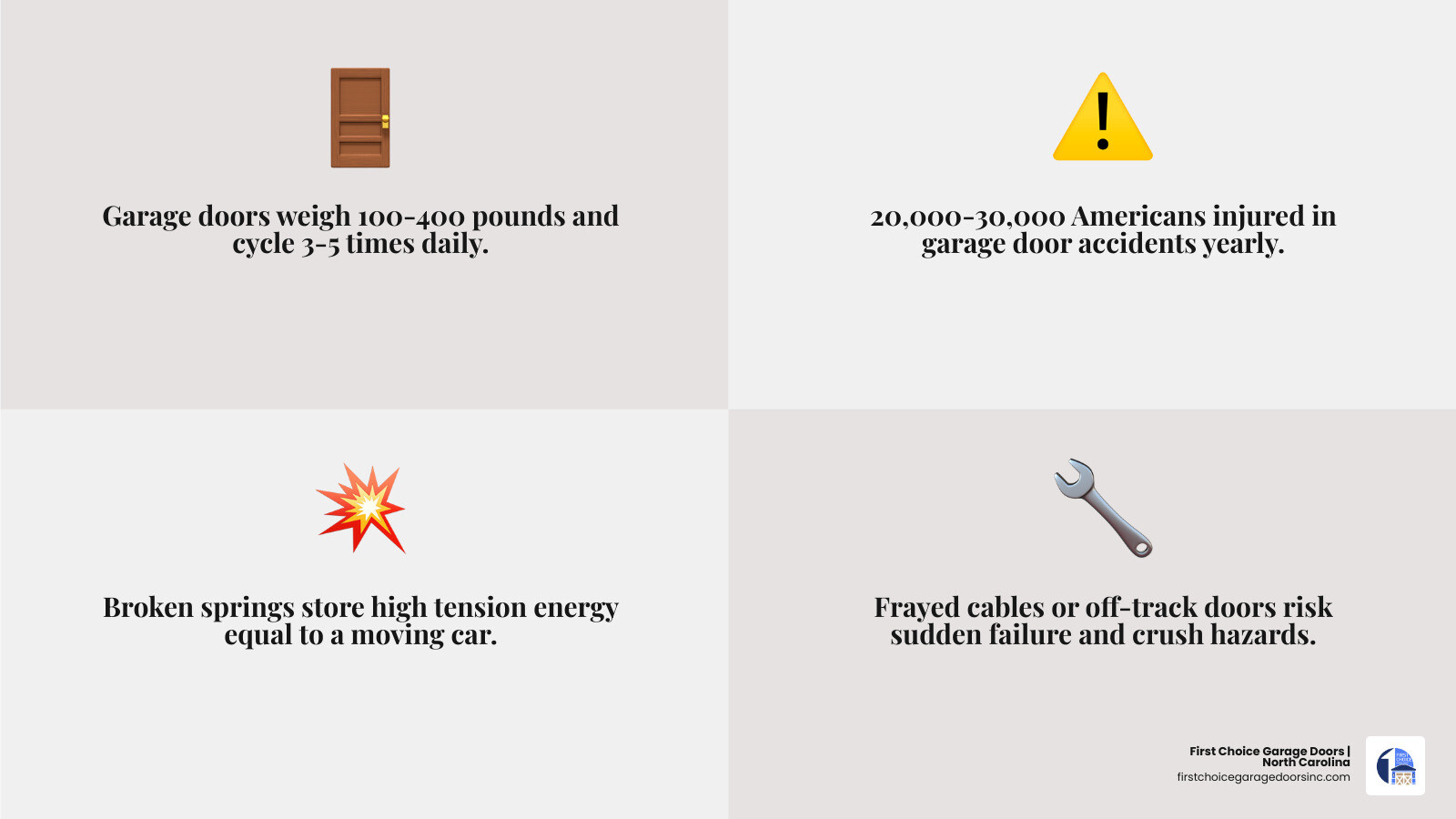
Knowing when to call a professional for garage door problems could be the difference between a quick fix and a serious injury. Your garage door is one of the heaviest moving parts in your home — most weigh between 100 and 400 pounds — and the average household opens and closes it three to five times every day. That’s a lot of stress on a system most people never think about until something goes wrong.
Call a professional for garage door problems when you notice any of the following:
- A loud snap or bang (likely a broken spring)
- Visible fraying or slack in the cables
- The door is off-track, crooked, or hanging unevenly
- The opener runs but the door doesn’t move
- The door falls faster than normal or won’t stay open
- Grinding, scraping, or banging sounds during operation
- The door reverses unexpectedly or won’t close completely
- Burning smell coming from the opener motor
For minor issues — like a dead remote battery, dirty sensors, or a squeaky hinge that needs lubrication — a careful DIY approach is usually fine. But anything involving springs, cables, tracks, or the opener’s electrical system should go straight to a pro.
Between 20,000 and 30,000 Americans are injured in garage door accidents every year. In Fayetteville, NC, the local humidity and seasonal temperature swings add extra wear on door hardware, making it even more important to catch problems early before they become dangerous.
I’m Tony Aguilar, founder of First Choice Garage Doors, Inc., with over 30 years of hands-on experience helping homeowners navigate exactly when to call a professional for garage door problems — and when a simple fix will do. In this guide, I’ll walk you through the clearest warning signs so you can make a confident, informed decision.

As we move through April 2026, we’ve seen plenty of garage doors struggle after a long winter. While it’s tempting to grab a ladder and a wrench, some issues are “system-level” failures that require a trained eye. If you ignore these signs, you aren’t just risking a stuck car; you’re risking the structural integrity of your home’s largest entrance.
- Sagging or Bending Panels: If you look at your door while it’s closed and notice the panels are bowing or sagging in the middle, the door’s structural integrity is compromised. This is common in older Residential Garage Doors that have faced years of North Carolina humidity.
- Uneven Hanging: Does one side of your door sit higher than the other when it’s partially open? This “crooked” look usually means one of your extension or torsion springs has lost its tension or a cable has slipped. This puts immense strain on the opener.
- Visible Wear on Hardware: We often see Commercial Garage Doors with rusted hinges or cracked rollers. If the metal parts look like they’re crumbling, they can no longer support the 400-pound weight of the door safely.
- Slow Response Time: If you hit the button and your door hesitates for more than a second or two before moving, there’s a communication breakdown between the opener and the door. It could be a failing motor or a signal interference issue.
- Frequent Reversals: A door that starts to close and then pops back up without any obstruction is telling you its safety system is failing. While sometimes it’s just a dirty sensor, frequent reversals often point to a Garage Door Repair need involving the internal logic board.
If you’re seeing these signs at your home in Fayetteville or across our other Locations, it’s time to step back from the toolbox.
Identifying When to Call a Professional for Garage Door Problems in Fayetteville
Our local climate in Fayetteville, NC, is unique. We deal with high humidity that can warp wooden panels and cause metal components to corrode faster than they would in drier states. When the salt from the air or seasonal moisture gets into the tracks, it creates a “sticky” residue that forces the motor to work twice as hard.
We recommend performing seasonal checks every spring and fall. Look for rust on the springs and check if the weather stripping is cracked. If you aren’t sure if your door is just “acting up” or truly failing, you can use our Garage Door Estimator to get a better idea of what a professional inspection might entail.
Unusual Noises and Grinding Sounds
A healthy garage door should operate with a steady, rhythmic hum. If your door sounds like a blender full of marbles, something is wrong.
- Grinding: Usually indicates worn-out metal rollers or a lack of lubrication on the tracks.
- Squealing: Often points to misaligned tracks or hinges that are binding.
- Banging: This is the sound of “pre-failure.” It often happens when the door is struggling to pass a bent section of the track.
Ignoring these sounds is like ignoring a chest pain—it’s a warning that a major “cardiac event” for your garage door is imminent. Regular Garage Door Maintenance can catch these noises before they turn into a full system collapse.
Why DIY Spring and Cable Repairs are Dangerous
This is the most important section of this guide. If there is one thing we want Fayetteville homeowners to remember, it is this: Never attempt to repair or replace garage door springs yourself.
Garage door springs are under “extreme tension.” They are responsible for lifting a door that weighs as much as a small refrigerator. When a spring snaps, it releases all that stored energy in a fraction of a second. We’ve seen springs fly through drywall and even car windshields.
High-Tension Hazards and Snapped Cables
The cables on your door work in tandem with the springs. They have a high tensile strength designed to pull the weight of the door upward. If a cable is frayed—meaning you see little “hairs” of wire sticking out—it is a ticking time bomb.
If that cable snaps while you are standing nearby, it can whip around with enough force to cause deep lacerations or worse. This is why our Services always include a safety inspection of the entire lifting assembly. We have the specialized winding bars and tensioning tools required to handle these parts without putting anyone in the hospital.
Heavy Door Risks and Structural Weight
As mentioned, these doors weigh between 100 and 400 pounds. If the springs are broken, that weight is no longer “offset.” If you try to lift the door manually, you are essentially deadlifting a massive steel or wood panel.
One slip, and the door can crash down, leading to “crush hazards” for fingers, feet, or anyone standing in the path. A door that has lost its balance is unpredictable. It might stay up for a minute and then drop without warning. This is a primary reason to stick with professional Residential Garage Doors experts who use specialized bracing to keep the door secure during repairs.
Emergency Situations Requiring Immediate Expert Help
Some problems can wait until Monday morning, but others are true emergencies. If your car is trapped inside and you have a flight to catch at Fayetteville Regional Airport, or if your door is stuck wide open at 10:00 PM, you have a security breach on your hands.
In these cases, we recommend you Contact Us immediately. Do not try to “force” the door closed, as this often bends the tracks and turns a $200 repair into a $2,000 replacement.
Off-Track Doors and Misaligned Rails
An “off-track” door is one of the most dangerous sights in a garage. This happens when the rollers pop out of the metal guides, usually because the door hit an object or a cable snapped.
When a door is off-track, it is no longer supported by the rail system. It is literally hanging by a thread. If you try to pull it, the entire door could fall out of the ceiling. We use specialized clamps and alignment tools during Garage Door Installation and repair to safely guide the door back into its tracks.
Knowing When to Call a Professional for Garage Door Problems with Your Opener
The opener is the “brain” of the system. While many people think a dead opener just needs a new battery, there are deeper signs of trouble:
- Burning Smells: If you smell ozone or burnt plastic, the motor is overheating. Unplug it immediately to prevent a fire.
- Constant Humming: If the motor hums but the chain or belt doesn’t move, the internal gears (often made of nylon) have likely stripped.
- Erratic Movement: If the door moves a few inches and stops, the “travel limits” or the logic board are failing.
Modern Garage Door Openers are complex computers. DIY electrical work on these units can void your warranty and lead to further damage.
Safe DIY Maintenance vs. Professional Servicing
We love proactive homeowners! There are several things you should do to keep your door running smoothly. However, knowing your limits is key to safety.
| Task | Safe for DIY? | Why? |
|---|---|---|
| Testing Safety Sensors | Yes | Just wave a broom under the door while it’s closing. |
| Cleaning Tracks | Yes | Use a damp cloth to remove cobwebs and dirt. |
| Lubricating Hinges | Yes | Use a silicone-based spray (not WD-40). |
| Tightening Hinges | Yes | A standard socket wrench can keep hardware snug. |
| Adjusting Spring Tension | NO | High risk of severe injury or death. |
| Replacing Cables | NO | Cables are under the same tension as springs. |
| Track Realignment | NO | Requires precision leveling to prevent door collapse. |
| Opener Logic Board Repair | NO | High risk of electrical shock or shorting the system. |
For everything in the “NO” column, our Garage Door Maintenance program provides a comprehensive 25-point inspection to ensure every bolt and wire is exactly where it needs to be.
Frequently Asked Questions about Garage Door Repair
How often should I have my garage door professionally serviced?
We recommend a professional tune-up at least once a year. Think of it like an oil change for your car. Most springs are rated for about 10,000 cycles (one cycle is one open and one close). For the average Fayetteville family, that means the springs will last about 7 to 10 years. Annual Services allow us to catch hairline fractures in the springs before they snap on a Tuesday morning while you’re late for work.
What should I do if my garage door opens by itself?
This is a major security risk! Usually, this is caused by “signal interference” from a neighbor’s remote or a short circuit in the wall-mounted button. In some cases, it’s a faulty logic board. First, check your remotes to make sure a button isn’t stuck. If that doesn’t fix it, Contact Us to have us clear the opener’s memory and reprogram your secure codes.
Can North Carolina weather affect my garage door performance?
Absolutely. In Fayetteville, the high humidity can cause metal parts to oxidize (rust) and wooden doors to swell or “heavy up.” During the rare cold snaps we get, the metal in the springs can become brittle. If your door feels “stiff” during a humid July morning, it’s likely because the lubrication has broken down or the tracks have slightly expanded.
Conclusion
At First Choice Garage Doors, we’ve spent decades serving the Fayetteville community. We know that your garage door is more than just a piece of metal; it’s the primary security gate for your home and family.
When to call a professional for garage door problems isn’t just a question of convenience—it’s about safety. Attempting to fix a 400-pound door or a high-tension spring without the right training is a gamble you don’t need to take. Whether you need a simple tune-up or an emergency Garage Door Repair, our team is ready to provide prompt, professional, and—most importantly—safe service.
Don’t wait for that “loud snap” to happen. Give us a call today, and let’s make sure your door stays on track for years to come.